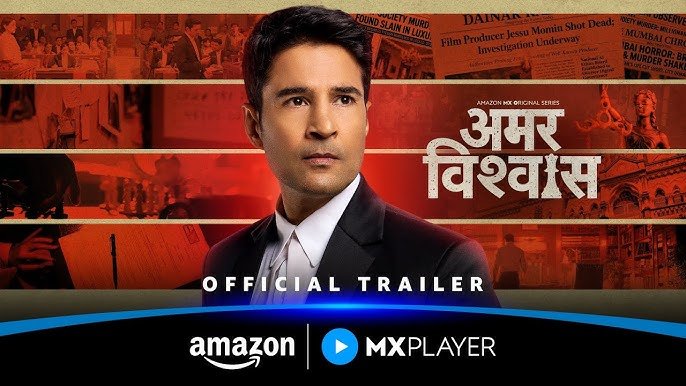
Let me tell you, Rajeev Khandelwal walking into a courtroom with that controlled fire in his eyes is something Indian web series has needed for a long time. He commands every scene with the kind of presence that makes you forget you are watching a screen. The problem is that everything happening around him in that courtroom belongs to a version of the Indian judicial system that exists only in fiction.
Amar Vishwas arrives on Amazon MX Player on February 11, 2026, adapted from Suhas Shirvalkar’s book and directed by Shashant Shah. It is a legal thriller built on a genuinely compelling premise. A fearless eccentric lawyer defending a woman the whole city has already convicted. The show gets the lead performance absolutely right and almost everything else somewhat wrong.
Amar Vishwas (2026) – Series Overview
| Detail | Information |
|---|---|
| Series Name | Amar Vishwas |
| OTT Platform | Amazon MX Player (Prime Video) |
| Release Date | February 11, 2026 |
| Language | Hindi |
| Genre | Legal Thriller, Courtroom Drama, Crime |
| Director | Shashant Shah |
| Based On | Novel by Suhas Shirvalkar |
| Producers | Kartik D. Nishandar, Arjun Singgh |
| Production House | GSEAMS |
| Lead Actor (Amar Vishwas) | Rajeev Khandelwal |
| Lead Actress (Bahar Chakravarty) | Payal Arora |
| Victim (Jessu Momin) | Ali Hassan |
| Supporting Cast | Ravi Behl, Barkha Bisht, Aamir Ali, Anil Charanjeett, Urvashi Pardeshi, Garvita Sadhwani, Saurabh Gokhale, Rushad Rana, Nysha Bijlani, Siddharth Shaw, Pankhuri Gidwani, Vihaan Nishandar, Sushil Bonthiyal |
| Total Episodes | 10 Episodes |
| IMDB Rating | 8.2 / 10 (Individual episodes) |
| Content Rating | U/A |
| Setting | Mumbai |
Brief Overview – What Is Amar Vishwas About?
A powerful Bollywood film producer named Jessu Momin is found murdered in a Mumbai hotel room. The evidence is overwhelming, the media has already delivered its verdict, and the accused is a woman named Bahar Chakravarty who appears to have both motive and opportunity.
Also Read




Amar Vishwas is a brilliant, eccentric Mumbai lawyer with an unbreakable principle at his core: if a person is truly innocent, justice must be delivered even if it means crossing every boundary the system places in front of him. Shaped by a painful past that the series reveals carefully across its ten episodes, he takes on Bahar’s defence and begins dismantling a case that is far more constructed than it appears. Power, betrayal, and hidden truths accumulate as the trial progresses and Amar realises that justice here means fighting an entire ecosystem built to ensure it never arrives.
Section 1: The Story – Gripping Premise, Procedural Problems
Suhas Shirvalkar’s source novel gives the series a solid architectural foundation. The murder of a powerful man, a female accused who cannot defend herself convincingly, a lawyer who sees what no one else is willing to see, and a web of connected interests determined to protect the verdict the case has already been given. These are strong building blocks and the series uses them with reasonable confidence in its first four episodes.
The procedural accuracy is where the series attracts its most significant criticism. Early IMDB reviewers who appear to have legal backgrounds describe the courtroom sequences as showing no understanding of how the Indian judicial system actually functions. Evidence is handled incorrectly. Legal procedure is simplified to the point of misrepresentation. Arguments that would never be permitted in a real Indian courtroom are delivered as dramatic set pieces.
For viewers who do not have a legal background this will not disrupt the watching experience. For those who do it creates a persistent friction that the lead performance is not always able to overcome. The series works best when it stays in the world of human motivations and personal history and struggles most when it tries to be technically credible.
Section 2: Performances – Khandelwal Carries the Weight
Rajeev Khandelwal as Amar Vishwas
Rajeev Khandelwal is the reason to watch this series and the reason it works as well as it does despite its procedural limitations. His Amar Vishwas is not a flashy, quote-generating hero lawyer. He is a man of controlled fire, someone who has built his entire identity around a principle born from private pain. Khandelwal plays that interiority with complete authority.
His courtroom sequences, even when the legal procedure they depict is inaccurate, carry dramatic conviction because he performs them as if every word costs him something. His physical stillness before an argument, the way he chooses which battles to fight loudly and which to win quietly, and the slow revelation of what drove him to become who he is, are all executed with the discipline of a performer who has spent years understanding exactly how much to reveal and when.
Payal Arora as Bahar Chakravarty
Payal Arora plays the accused with a quiet desperation that grounds the series in human stakes rather than legal mechanics. Her Bahar is not written as a symbol or a plot device. She is a woman trying to survive a system that has decided her guilt before the trial begins. Arora communicates that survival instinct with restraint and the scenes between her and Khandelwal carry the series’ most genuine emotional weight.
Ravi Behl as the Opposing Force
Ravi Behl plays the antagonist of the judicial battle against Amar Vishwas with the controlled smugness of a man who has never lost and does not expect to start now. His dynamic with Khandelwal is the series’ best recurring tension. The courtroom exchanges between them are the show at its most purely entertaining regardless of their procedural accuracy.
Barkha Bisht, Aamir Ali and the Supporting Ensemble
Barkha Bisht as Mohini and Aamir Ali as Akbar Baig both deliver performances that serve the series’ ensemble structure without being given enough individual character development to be truly memorable. The supporting cast is competent across the board and no single performance actively hurts the series. The limitation is that the writing spreads its attention too thinly in the middle episodes and some potentially interesting supporting characters end up underdeveloped.
Section 3: Direction and Writing – Shashant Shah’s Controlled Pace
Director Shashant Shah keeps the series moving with a steady, controlled hand. He understands that Rajeev Khandelwal is the series’ primary asset and he consistently puts the camera in positions that let the actor do his best work. Close-up choices in the courtroom sequences, the way individual scenes are blocked to isolate Amar from the crowd around him, and the deliberate pacing of revelation scenes all reflect a director who is thinking about character before spectacle.
The writing struggles most in the episodes where the legal procedure is expected to carry dramatic weight independently of performance. When the script asks the courtroom mechanics to do what only character work can do, the procedural inaccuracies become more visible and more damaging to the viewing experience. The series is at its best in the quieter scenes between Amar and Bahar and at its least convincing when it tries to generate suspense from legal technicalities it has not researched adequately.
Section 4: Technical Craft – Mumbai in Grey
The cinematography shoots Mumbai with a grey, overcast palette that suits the moral ambiguity of the story. The courtroom is lit to feel institutional and impersonal, which correctly places Amar’s warmth and fire in sharp contrast with the cold machinery around him. The visual grammar is not ambitious but it is consistent and it serves the series’ tonal register without calling attention to itself.
The sound design is functional. The background score avoids the mistake of over-dramatising the legal proceedings and mostly knows when to step back and let performance and dialogue do the work. The overall technical package is competent and occasionally effective without being a creative highlight of the series.
| Aspect | Rating | Comment |
|---|---|---|
| Rajeev Khandelwal as Amar | 5 / 5 | Outstanding. The series is built around him and he delivers completely. |
| Payal Arora as Bahar | 4 / 5 | Restrained, human, and the series’ emotional anchor. |
| Ravi Behl as the Opposition | 3.5 / 5 | Controlled and effective. Best when sparring directly with Khandelwal. |
| Writing and Premise | 3.5 / 5 | Strong foundation from the source novel. Weakens in procedural episodes. |
| Legal Accuracy | 1.5 / 5 | Widely criticised. Not recommended viewing for legal professionals. |
| Direction (Shashant Shah) | 3.5 / 5 | Character-first approach works well. Spectacle sequences less convincing. |
| Cinematography | 3 / 5 | Consistent and appropriate. Not a creative highlight. |
| Pacing Across 10 Episodes | 3 / 5 | Some middle episodes drag. Stronger at the beginning and end. |
Section 5: Moments That Make the Series Worth Watching
- Amar’s First Courtroom Entry: The moment Rajeev Khandelwal walks into the courtroom for the first time and the opposing counsel registers who he is. Not a word is spoken. The entire dynamic of the series is established through eye contact and posture alone. It is a masterclass in performance economy.
- Bahar and Amar’s First Private Meeting: The scene where Amar tells Bahar he will take her case not because he believes she is innocent but because the case itself tells him something important about how justice is being managed. Khandelwal and Arora’s chemistry in this scene is the series’ best writing and acting combined.
- The Hidden Motive Reveal: The episode where the true shape of Jessu Momin’s relationships begins to emerge. The series earns its thriller designation here as the web of connected interests becomes visible for the first time. The writing is at its most confident and the episode ends on one of the series’ best cliffhangers.
- Amar vs Ravi Behl’s Character Directly: The courtroom exchange where the two lead legal minds finally stop circling and confront each other directly. The dialogue in this scene may not reflect real Indian courtroom procedure but as dramatic writing it is sharp, fast, and completely compelling.
- The Episode “Faisle ke Baad”: The aftermath episode following a major case development. It is the series’ most emotionally honest hour and the one where Khandelwal is given the most room to show what Amar Vishwas has cost the man behind the principle. One of the best individual episodes in an Indian legal drama series in recent memory.
Section 6: How Does Amar Vishwas Compare to Other Indian Legal Dramas?
Indian OTT legal dramas have a complicated recent history. Criminal Justice set a high benchmark for procedural character work. Guilty Minds surprised audiences with its legal accuracy and moral complexity. Your Honor delivered emotional power through personal stakes rather than courtroom mechanics. Amar Vishwas sits closest to the Your Honor end of that spectrum, a series where the legal drama is primarily a container for character work rather than a technically credible procedural.
For viewers who value legal accuracy above all other qualities in this genre, Kohrra Season 2 and Guilty Minds will serve them better. For viewers who want to watch Rajeev Khandelwal do the best work of his recent career inside a legal thriller framework that does not get in its own way too often, Amar Vishwas delivers exactly that.
Final Verdict – Is Amar Vishwas Worth Your Time on MX Player?
Yes, with a clear understanding of what you are getting. Amar Vishwas is not a procedurally accurate legal drama. It is a character-driven thriller about a man of principle operating inside a corrupt system, and on those terms it frequently succeeds.
Rajeev Khandelwal gives the performance of his recent career. The premise from Suhas Shirvalkar’s source material is strong. Payal Arora as Bahar grounds the series in human stakes. And the series’ best episodes, particularly Faisle ke Baad, prove that when the writing trusts its characters more than its courtroom mechanics, Amar Vishwas can be genuinely excellent.
Watch it for Khandelwal. Accept its procedural limitations. Engage with the character and the case. Amar Vishwas is a flawed but frequently rewarding ten-episode legal thriller that deserves more credit than its courtroom inaccuracies have allowed it to receive.
Frequently Asked Questions
1. Is Amar Vishwas based on a real case or a real person?
No. Amar Vishwas is adapted from a novel by Marathi author Suhas Shirvalkar. The character of lawyer Amar Vishwas and the murder case at the centre of the series are entirely fictional. The series is set in Mumbai and draws on the general atmosphere of the city’s media and film industry world but does not depict any real events or real individuals.
2. Where can I watch Amar Vishwas and is it free?
Amar Vishwas streams on Amazon MX Player, which is available through the Prime Video platform. It is also available via Airtel Xstream Play. MX Player content on Amazon is accessible to Prime Video subscribers. The series is available in Hindi with all ten episodes released simultaneously from February 11, 2026.
3. How accurate is Amar Vishwas in depicting the Indian judicial system?
Reviewers with legal backgrounds have specifically criticised the series for inaccurate depiction of Indian courtroom procedure, noting that the producers and director appear to have limited familiarity with how the judicial system actually operates. For viewers seeking procedural accuracy, the series is not recommended as a reference. For viewers primarily interested in character drama and thriller storytelling within a legal setting, the inaccuracies are manageable and the series delivers strong entertainment regardless.

Priyanka Das is an SEO expert and digital researcher based in Didwana-Kuchaman, Rajasthan, India. He is the founder and sole creator of Filmyzilla99.in, where he researches and publishes informational content on Movies Review using trusted sources. While not a movie professional, his work focuses on accurate research, clear explanations, and responsible content practices to help readers better understand Movies Review topics.