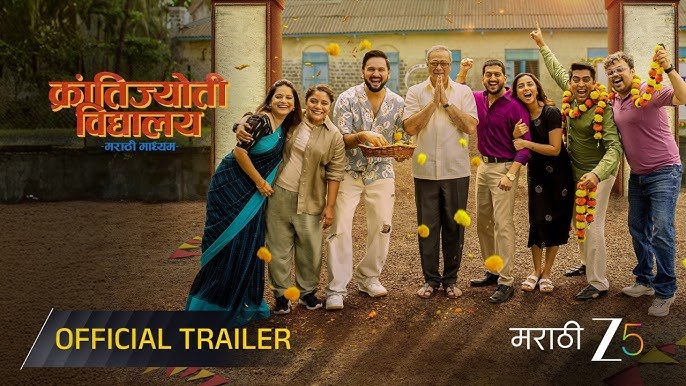
A film that delivers 500 percent returns in four weeks and crosses 600 percent by 50 days is not a fluke. Krantijyoti Vidyalay Marathi Madhyam released on January 1, 2026, and Maharashtra responded in a way that the industry had not seen for a Marathi social drama in years.
It grossed over Rs 32.27 crore in seven weeks. A sequel was announced on February 5. The film now arrives on Marathi ZEE5 on February 27, timed exactly to Marathi Bhasha Gaurav Din. The timing is not accidental. This film is a statement.
Directed by Hemant Dhome and produced by Kshitee Jog, Viraj Gawas, Urfi Kazmi, and Ajinkya Dhamal, the film is a 149-minute social drama set in Alibaug. It holds a 9.3 on IMDB and reviews ranging from 3.5 to 4 out of 5 stars from Maharashtra Times, Film Companion, and Scroll. It is not a perfect film. It is a necessary one.
Krantijyoti Vidyalay Marathi Madhyam (2026) – Film Overview
| Detail | Information |
|---|---|
| Film Name | Krantijyoti Vidyalay Marathi Madhyam |
| Theatrical Release | January 1, 2026 |
| OTT Platform | Marathi ZEE5 |
| OTT Release Date | February 27, 2026 (Marathi Bhasha Gaurav Din) |
| Language | Marathi |
| Genre | Social Drama, Family Film, Nostalgia Drama |
| Director | Hemant Dhome |
| Producers | Kshitee Jog, Viraj Gawas, Urfi Kazmi, Ajinkya Dhamal |
| Dinkar Shirke (Principal) | Sachin Khedekar |
| Anjali Rane | Prajakta Koli (Marathi Film Debut) |
| Baban Mhatre | Amey Wagh |
| Kuldeep Nagavkar | Siddharth Chandekar |
| Salma Hasina Aantule | Kshitee Jog |
| Suman Bhoir | Kadambari Kadam |
| Rakesh Gharat | Harish Dudhade |
| Vishal Bhoir | Pushkaraj Chirputkar |
| Mrs. Shirke | Nirmiti Sawant |
| Setting | Alibaug, Maharashtra |
| Runtime | 149 minutes (2 hours 29 minutes) |
| IMDB Rating | 9.3 / 10 |
| Box Office Total | Rs 32.27 crore in 7 weeks |
| Returns | 500 percent in 4 weeks, 600 percent by 50 days |
| Sequel | Announced February 5, 2026 |
Brief Overview – What Is Krantijyoti Vidyalay About?
A 90-year-old Marathi-medium school in Alibaug is facing two simultaneous threats: its dilapidated infrastructure is deemed unfit, and a corrupt politician-developer wants the land to build an international English school.
Also Read




Principal Dinkar Shirke refuses to let the school die quietly. He calls back the school’s alumni, a scattered, reluctant, and bickering group, to mount a fight for the institution that shaped them.
What begins as a legal and political battle becomes something much deeper. The returning alumni are forced to reckon with who they were, who they became, and what their Marathi-medium education actually gave them in a world that now tells their children it is not enough.
The film is simultaneously a school reunion comedy, a political drama, and a cultural argument made on behalf of a language that is being slowly crowded out by aspiration.
Section 1: The Story – Nostalgia With a Purpose
Hemant Dhome’s screenplay does something that separates Krantijyoti Vidyalay from the usual Marathi social drama. It does not sentimentalise the Marathi-medium school. It argues for it.
The distinction matters. The film acknowledges why parents are choosing English education for their children, the economic pressures, the employment realities, the status anxieties, and then makes the case that something irreplaceable is being lost in that transaction without dismissing the people making the choice.
Nandini Ramnath of Scroll.in noted that the 149-minute film takes too long to spell out its intent and then keeps wandering off after it has done so. The criticism is fair. The second half loses momentum in stretches as multiple alumni subplots compete for screen time.
Some threads are resolved too quickly and others linger too long. The film’s emotional engine, the relationship between Shirke and his school, remains powerful throughout, but the writing around it is uneven in the final third.
What keeps the story honest is its refusal to make the villain simply corrupt and the heroes simply pure. Every character carries ambivalence about their relationship to Marathi identity and that ambivalence is the most truthful thing the film produces.
The climactic movement to save the school works because the film has earned it through character work rather than manufactured crisis.
Section 2: Performances
Sachin Khedekar as Dinkar Shirke
Khedekar is the film’s spine. His principal is not a saint or a symbol. He is a man who loves his school with the quiet, undemonstrative devotion of someone who has given his life to it and cannot imagine what the alternative would look like. Khedekar plays authority with restraint and grief with dignity.
His silences carry more weight than most dialogue scenes in the film. The IMDB audience review that described his performance as embodying the principal with subtle authority is the most accurate single description of what he does here.
Prajakta Koli as Anjali Rane
This is Prajakta Koli’s Marathi film debut and she handles the transition from digital content creation to dramatic feature filmmaking with confidence. Her Anjali is the film’s modern voice, someone who has built a successful life outside the Marathi-medium world and now returns to it with complicated feelings.
Koli plays the complexity without over-explaining it. Her scenes with Khedekar reveal an actor willing to be small in scenes rather than compete for attention. That restraint is the right instinct and it pays off.
Amey Wagh as Baban Mhatre
Wagh provides the film’s most reliable comic energy. His Baban is the alumni member who never quite left the school’s emotional orbit and whose nostalgia is both the most sincere and the most comically expressed of the group.
Wagh’s timing is immaculate and his scenes with Siddharth Chandekar generate the easy banter of people who have known each other for decades. He described what drew him to the film as its emotional honesty and the quiet power of its message. Both qualities are visible in his performance.
Siddharth Chandekar, Kshitee Jog and the Ensemble
Chandekar as Kuldeep and Kshitee Jog as Salma both bring specific texture to their alumni characters that the film needs to make its reunion premise work. Kadambari Kadam and Harish Dudhade serve the ensemble structure reliably.
Nirmiti Sawant as Mrs. Shirke delivers the film’s most understated emotional performance in limited screen time, a teacher’s wife who watches everything and says very little and communicates volumes in both choices.
Section 3: Technical Craft
The Alibaug setting is used with real affection. The school itself, shot on location rather than on a constructed set, has the specific physical memory that only a real building can carry. Corridors with names scratched into walls.
Classrooms where the light falls the same way it has for ninety years. These details are not incidental. They are the film’s argument made visually rather than verbally.
The music serves the film’s nostalgic register without tipping into sentimentality. The background score knows when to be present and when to leave silence alone. The overall technical craft is clean, functional, and occasionally genuinely beautiful in its handling of the school’s physical spaces.
| Aspect | Rating | Comment |
|---|---|---|
| Sachin Khedekar as Shirke | 5 / 5 | Subtle, authoritative, and deeply felt throughout. |
| Prajakta Koli’s Debut | 4 / 5 | Confident and restrained. A genuinely promising Marathi film debut. |
| Amey Wagh as Baban | 4 / 5 | The film’s comic engine. Timing is consistently sharp. |
| Supporting Ensemble | 3.5 / 5 | Solid across the board. Some characters underdeveloped in the third act. |
| First Half Writing | 4 / 5 | Argument and emotion in strong balance. Sets up the film well. |
| Second Half Writing | 3 / 5 | Loses momentum. Some subplots compete without resolving cleanly. |
| Location and Cinematography | 4 / 5 | Real school, real Alibaug. The physical authenticity does the film’s work. |
| Cultural and Social Argument | 5 / 5 | Honest, non-preachy, and genuinely necessary. |
Section 4: Moments That Stay With You
- Shirke’s First Assembly: The opening scene of Khedekar calling students to assembly in a half-empty courtyard. The gap between what the school was and what it has become is established in a single image without a word of exposition.
- The Alumni Reunion First Dinner: The first time the old classmates are back in the same room. Amey Wagh and Siddharth Chandekar’s banter restores the film’s energy after its more serious opening stretch and reminds the audience why reunion films work when the cast chemistry is real.
- Anjali’s Confrontation Scene: Prajakta Koli’s best scene in the film. Anjali is asked directly why she left, what she gained, and what she thinks she lost. Koli answers with her face more than her dialogue.
- Shirke and the Empty Classroom: A quiet scene mid-film where Khedekar sits alone in a classroom that will be demolished if the fight is lost. No score. No dialogue. Just a man and a room full of the time he has spent inside it.
- The Final Rally: The community movement that the film builds toward earns its emotion because the film has spent two hours making you care about the specific people carrying it. It is not generic uplift. It is the specific noise of specific people refusing a specific loss.
Final Verdict
Krantijyoti Vidyalay Marathi Madhyam is a film that deserved its audience and found one. Rs 32.27 crore for a Marathi social drama is not a number that arrives without genuine merit. The film is imperfect in its second half and occasionally too long for its own good.
But Sachin Khedekar’s performance, Prajakta Koli’s debut, Hemant Dhome’s honest handling of a real cultural anxiety, and the physical authenticity of the Alibaug school setting combine to produce something that rewards the time it asks for.
Its ZEE5 digital premiere on Marathi Bhasha Gaurav Din is the right platform and the right day. Watch it with your family. Think about what your own school gave you and what the language it taught you in means to the person you became.
Frequently Asked Questions
1. Where can I watch Krantijyoti Vidyalay Marathi Madhyam online?
The film’s world digital premiere is on Marathi ZEE5 from February 27, 2026. It is available to ZEE5 subscribers through the ZEE5 app and website.
The release date coincides with Marathi Bhasha Gaurav Din, the annual celebration of the Marathi language, which the makers have specifically cited as integral to the film’s message about mother-tongue education and cultural identity.
2. Is this film suitable for children and family viewing?
Yes. Krantijyoti Vidyalay Marathi Madhyam is a family-friendly social drama with no adult content, violence, or objectionable material.
It is particularly suited for families who want to watch something together that sparks conversation about education, language, and cultural identity. Children who attend or have attended Marathi-medium schools will find the film directly relevant to their own experience.
3. Has a sequel to Krantijyoti Vidyalay Marathi Madhyam been announced?
Yes. A sequel was officially announced by the makers at an honours ceremony on February 5, 2026, following the film’s extraordinary box office performance of 600 percent returns by its 50th day of release.
No cast details, release date, or story direction for the sequel have been confirmed yet. The original team of director Hemant Dhome and producer Kshitee Jog are expected to return for the second film.

Priyanka Das is an SEO expert and digital researcher based in Didwana-Kuchaman, Rajasthan, India. He is the founder and sole creator of Filmyzilla99.in, where he researches and publishes informational content on Movies Review using trusted sources. While not a movie professional, his work focuses on accurate research, clear explanations, and responsible content practices to help readers better understand Movies Review topics.