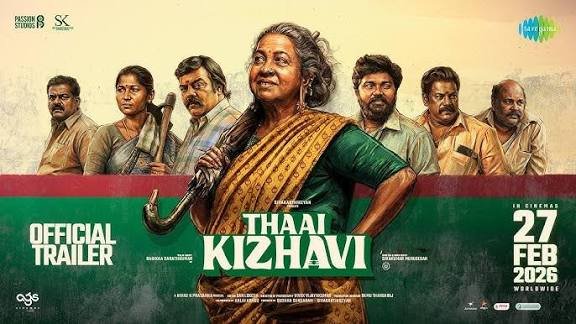
The overnight premiere shows in Tamil Nadu on February 26 gave this film five stars before the general audience had even bought their tickets. Director Atlee endorsed it publicly before release. The trade handle Lets Cinema called it a clean five.
Thaai Kizhavi walked into theatres on February 27 without a major star, without a massive budget, and without any significant Tamil competition in the same window. What it had instead was Radikaa Sarathkumar at the centre of a film that was written exactly for her. That is more than enough.
Directed by debutant Sivakumar Murugesan and produced by Sivakarthikeyan and Sudhan Sundaram under Sivakarthikeyan Productions and Passion Studios, Thaai Kizhavi is a rural Tamil comedy-drama with a U certificate, a budget under Rs 10 crore, and early Day 1 estimates placing its India gross in the Rs 1.25 to Rs 1.75 crore range. The numbers are modest. The impact is not.
Thaai Kizhavi (2026) – Film Overview
| Detail | Information |
|---|---|
| Film Name | Thaai Kizhavi |
| Release Date | February 27, 2026 |
| Language | Tamil |
| Genre | Rural Comedy Drama, Family Entertainer, Social Drama |
| Director | Sivakumar Murugesan (Debut) |
| Producers | Sivakarthikeyan, Sudhan Sundaram |
| Production Houses | Sivakarthikeyan Productions, Passion Studios |
| Co-Producer | Kalai Arasu |
| Cinematographer | Vivek Vijayakumar |
| Editor | San Lokesh |
| Music | Nivas K. Prasanna |
| Pavunuthaayi (Thaai Kizhavi) | Radikaa Sarathkumar |
| Supporting Cast | Singam Puli, Aruldoss, Bala Saravanan, Ilavarasu, Munishkanth, George Maryan, Vettai Muthukumar, Raichal Rabecca |
| Setting | Kadupatti Village, Usilampatti, Tamil Nadu |
| Certificate | U (Universal) |
| Budget | Under Rs 10 Crore |
| Screens | 450 plus in India |
| IMDB Rating | 8.5 / 10 |
| Indian Express Review | 4 / 5 Stars |
| India Today Review | 4 / 5 Stars |
| OTT Platform | JioHotstar (post-theatrical, date not confirmed) |
| Satellite Rights | Vijay Television |
| Opening Endorsement | Director Atlee (publicly, pre-release) |
Brief Overview – What Is Thaai Kizhavi About?
Pavunuthaayi is a 70-year-old woman in Kadupatti village near Usilampatti. She is feared, formidable, ruthless, and blunt. As the village moneylender, she enforces dues without sentiment and lives life entirely on her own terms.
Also Read




She has three estranged sons she has kept at distance for years. When she is found critically ill and bedridden, those three sons return, not out of love but out of calculation. Each one believes she is sitting on hidden wealth and each one is determined to get their share.
What they find when they return is not a dying woman waiting to be divided. What they find is Pavunuthaayi, still entirely herself even from a sickbed, still sharper than every person trying to outwit her, and still completely uninterested in becoming the passive subject of anyone else’s plan.
The film is a comedy about greed and a drama about dignity. It is also, quietly, a film about financial independence and what it means for a woman to own the terms of her own life.
Section 1: The Story – Satire With a Social Spine
Sivakumar Murugesan’s debut screenplay is smarter than its premise suggests. A dying village moneylender and her scheming sons sounds like a dark comedy of the kind Tamil cinema produces regularly. What separates Thaai Kizhavi is the film’s consistent refusal to let the comedy come at Pavunuthaayi’s expense.
She is never the butt of the joke. She is the source of every joke the film lands on her sons, her neighbours, and everyone who underestimates what a woman who has spent 70 years refusing to be underestimated can still do from a sickbed.
India Today’s reviewer described the film as quietly radical. The assessment is accurate. The film champions financial independence and women’s agency without ever feeling like a lecture.
It does this by simply showing a woman who has always lived those values and then watching what happens when the world around her tries to treat her illness as an opportunity. Her response to that attempt is the film’s entire dramatic and comic engine.
The Usilampatti rural setting is specific and lived-in. Sivakumar Murugesan clearly knows this world and writes it from the inside. The village’s social hierarchies, its gossip networks, its specific relationship to money and land and inheritance are all part of the story’s texture rather than simply its backdrop.
The film works best when it trusts that specificity rather than reaching for broader comedy beats.
Section 2: Performances
Radikaa Sarathkumar as Pavunuthaayi
The Indian Express called her performance a reminder to everyone why she belongs at the centre of a film. That is both accurate and an understatement.
Radikaa Sarathkumar plays Pavunuthaayi with the specific authority of an actor who has spent decades earning the right to command every frame she appears in. Her Pavunuthaayi is not a warm grandmother figure. She is sharp, unsentimental, occasionally terrifying, and completely real.
The performance is most impressive in the film’s quieter moments. Pavunuthaayi watching her sons scheme around her sickbed while pretending to be unaware. Pavunuthaayi choosing exactly when to deploy her knowledge and exactly when to let silence do the work.
These are the moments where the film earns its critical praise and they are all created by Radikaa Sarathkumar making choices that a lesser actor would not think to make. Audience reactions from Day 1 shows singled her out as award-worthy. The assessment is not premature.
Singam Puli, Aruldoss and Bala Saravanan as the Sons
The three sons are written as distinct comic types and the three actors inhabit them with the easy confidence of performers who know exactly what a Tamil rural comedy needs from supporting characters. Singam Puli brings his trademark timing.
Aruldoss anchors the more dramatically weighted son with conviction. Bala Saravanan provides the ensemble’s funniest sustained performance. The three together generate the specific chaotic energy that Pavunuthaayi’s stillness makes funnier by contrast.
Ilavarasu, Munishkanth, George Maryan and the Village Ensemble
The village ensemble is the film’s social texture made visible. Ilavarasu, Munishkanth, and George Maryan are all experienced character actors who understand exactly how to populate a rural Tamil world convincingly.
Their scenes are not transitional. They carry the film’s satirical awareness of how village politics intersects with family drama and they deliver that awareness with the lightness good comedy requires.
Section 3: Technical Craft
Vivek Vijayakumar’s cinematography shoots the Usilampatti rural landscape with warmth and familiarity. The visual language is not cinematic in any ambitious sense but it is honest and it serves the story’s grounded, specific tone.
The choice to shoot in real village locations rather than constructed sets gives the film the physical authenticity that its social argument requires.
Nivas K. Prasanna’s music is the film’s most culturally rooted technical element. The first single Thaai Kizhavi Varaa, sung by Sivakarthikeyan himself, was released on February 5 and built early audience goodwill for the film. The second single Mattikitan Minorkunju gave the promotional campaign its folk texture.
The background score knows when to support the comedy and when to step back and let the drama breathe. San Lokesh’s editing keeps the film moving without sacrificing the scenes that the story’s emotional register needs to develop properly.
| Aspect | Rating | Comment |
|---|---|---|
| Radikaa Sarathkumar | 5 / 5 | Award-worthy. The entire film rests on her and she carries it completely. |
| Three Sons Ensemble | 4 / 5 | Distinct, funny, and well-calibrated against Radikaa’s stillness. |
| Village Supporting Cast | 3.5 / 5 | Reliable and specific. Populates the world convincingly. |
| Debut Direction | 4 / 5 | Smart premise handled with confidence. Knows its world from the inside. |
| Social Argument | 4.5 / 5 | Quietly radical without being preachy. The film’s strongest quality. |
| Music (Nivas K. Prasanna) | 3.5 / 5 | Folk-rooted and appropriate. Songs serve the story rather than interrupt it. |
| Cinematography | 3 / 5 | Honest and location-specific. Not visually ambitious but entirely fitting. |
| Pacing | 3.5 / 5 | Steady. Some middle stretches could be tighter but never loses the thread. |
Section 4: Moments That Define the Film
- Pavunuthaayi’s Introduction: The opening sequence establishes who she is without exposition. The village’s reaction to her presence, the way people straighten up or step aside, tells you everything about the kind of woman the film is built around. Radikaa Sarathkumar commands the frame before she has spoken a word.
- The Sons Arrive: The three sons returning to the village after years away is staged as a comedy of assumptions. Each one arrives believing he understands the situation. None of them does. The film’s central dramatic irony is established here and it is sustained perfectly across what follows.
- Pavunuthaayi Watches and Waits: The recurring motif of Pavunuthaayi observing her sons scheme while pretending to be too ill to notice is the film’s comic engine. The audience’s awareness of what she actually knows versus what the sons believe she knows generates sustained, escalating pleasure across the middle of the film.
- The Money Conversation: The scene where the film’s argument about financial independence is most directly stated. It is also the scene where Radikaa Sarathkumar delivers her finest work. The line between comedy and social drama disappears here and the film is better for it.
- The Climax: The resolution does not deliver easy forgiveness or manufactured warmth. Pavunuthaayi’s terms are her own and the film respects them completely. It is the right ending for the woman the story has spent two hours building.
Final Verdict
Thaai Kizhavi is the kind of Tamil film that walks in quietly and fills the room. No explosion of a star. No massive action set piece. Just a 70-year-old woman in a sickbed refusing to be anyone’s pawn and a debut director smart enough to keep his camera on her face and let the performance do the work.
Radikaa Sarathkumar has spent decades earning a role this precisely right for her range. Sivakumar Murugesan gave her one. The result is the most important Tamil film of this February and one of the year’s finest female-centred performances in any language.
It is in 450 screens today. The rural heartland of Madurai and Tirunelveli is already responding. Word of mouth will do the rest. Watch it this weekend before the next big release crowds it out of screens. Pavunuthaayi deserves a full hall.
Frequently Asked Questions
1. Where can I watch Thaai Kizhavi on OTT?
Thaai Kizhavi’s post-theatrical streaming rights have been acquired by JioHotstar. The satellite rights have gone to Vijay Television.
An OTT release date has not been officially confirmed yet as the film released theatrically on February 27, 2026. Follow Sivakarthikeyan Productions and JioHotstar’s official channels for the confirmed digital premiere date once the theatrical run concludes.
2. Is Thaai Kizhavi suitable for family viewing?
Yes. The film holds a U certificate, meaning it is suitable for universal audiences including children. It is a clean rural comedy-drama with no adult content, violence, or objectionable material.
The film’s themes of family, greed, and women’s agency are handled with a lightness that makes it a genuinely enjoyable watch across age groups. It is specifically strong for viewers who enjoy Tamil rural comedies with a social message.
3. Who produced Thaai Kizhavi and why does the Sivakarthikeyan Productions banner matter?
Thaai Kizhavi is produced by Sivakarthikeyan and Sudhan Sundaram under Sivakarthikeyan Productions and Passion Studios. The Sivakarthikeyan Productions brand has a strong track record of backing content-driven Tamil films with commercial release infrastructure.
The banner’s involvement gave Thaai Kizhavi wider distribution across 450 screens in India and brought significant promotional credibility, including Sivakarthikeyan singing the film’s first single Thaai Kizhavi Varaa.
The first single’s association with his name gave the film early audience visibility beyond what a non-star-vehicle film typically generates.

Priyanka Das is an SEO expert and digital researcher based in Didwana-Kuchaman, Rajasthan, India. He is the founder and sole creator of Filmyzilla99.in, where he researches and publishes informational content on Movies Review using trusted sources. While not a movie professional, his work focuses on accurate research, clear explanations, and responsible content practices to help readers better understand Movies Review topics.