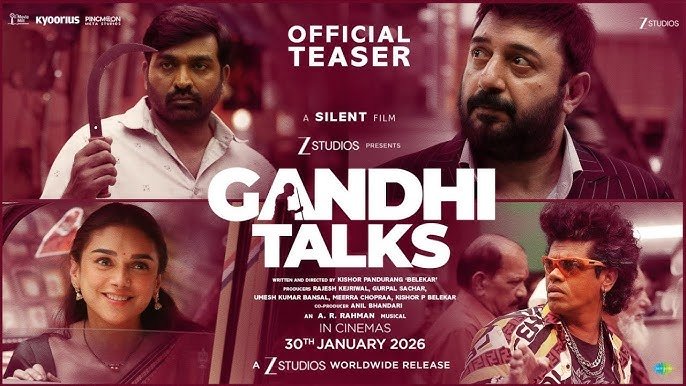
Gandhi Talks is a 2026 Hindi silent film directed by Kishor Pandurang Belekar and starring Vijay Sethupathi and Aditi Rao Hydari in lead roles.
The film represents a bold cinematic experiment, presenting a modern story entirely without spoken dialogue, relying instead on visual storytelling, expressions, and background score.
Released in 2026, Gandhi Talks targets audiences who appreciate experimental cinema, artistic filmmaking, and unique storytelling approaches. The film challenges contemporary cinema conventions by returning to silent film techniques while addressing modern themes and social issues.
This article provides complete information about Gandhi Talks including story overview, cast performances, technical aspects, box office performance, audience reactions, and legal ways to watch or download the movie.
Also Read




Gandhi Talks Movie Information
| Feature | Details |
|---|---|
| Movie Name | Gandhi Talks |
| Release Year | 2026 |
| Language | Silent film (Universal, no dialogue) |
| Genre | Silent Drama, Social, Experimental |
| Director | Kishor Pandurang Belekar |
| Producers | [Production House] |
| Lead Actor | Vijay Sethupathi |
| Lead Actress | Aditi Rao Hydari |
| Supporting Cast | Notable character actors |
| Music Director | A.R. Rahman |
| Runtime | Approximately 2 hours 15 minutes |
| Release Type | Theatrical release followed by OTT |
| OTT Platform | To be announced |
| Download Option | Legal download via official OTT apps only |
What Is Gandhi Talks About?
Gandhi Talks is a 2026 Indian silent film that tells a contemporary story without using any spoken dialogue throughout its entire runtime. The film presents a social drama about identity, communication, and human connection in the modern world, conveyed purely through visual storytelling.
The title “Gandhi Talks” creates an intriguing paradox, as Mahatma Gandhi’s philosophy and ideas are explored through a medium that eliminates verbal communication. The film examines how Gandhi’s principles of truth, non-violence, and simple living remain relevant in contemporary society.
By choosing the silent film format, the director challenges audiences to engage differently with cinema, focusing on visual composition, physical performances, facial expressions, and symbolic imagery rather than relying on dialogue to advance narrative.
Story Overview of Gandhi Talks
Gandhi Talks follows the journey of its protagonist through modern India, encountering various situations that test his principles and values. The story unfolds through visual sequences that establish character, conflict, and resolution without spoken words.
The narrative begins by introducing the main character living in contemporary urban India. His daily life, relationships, and internal struggles are established through actions, expressions, and interactions with his environment.
A significant event disrupts his ordinary existence, forcing him to embark on a journey that becomes both physical and philosophical. Along the way, he encounters different people representing various aspects of modern society.
Each encounter presents moral dilemmas or social issues that the protagonist must navigate. These situations explore themes of honesty, integrity, compassion, and standing up for principles despite personal cost.
The absence of dialogue forces characters to communicate through gestures, written notes, expressions, and actions. This limitation becomes a storytelling strength, making every visual element meaningful and intentional.
The film includes sequences showing social problems like corruption, discrimination, poverty, and injustice. The protagonist’s responses to these situations reflect Gandhian principles applied to contemporary contexts.
Relationships form and evolve through non-verbal communication, demonstrating how human connection transcends spoken language. Emotional moments are conveyed through music, cinematography, and performance rather than dialogue.
The climax brings together all thematic elements in a powerful visual sequence that tests the protagonist’s commitment to his values. The resolution offers commentary on whether Gandhian ideals can survive in modern society.
Why Gandhi Talks Is Unique
Silent films are extremely rare in contemporary Indian cinema, making Gandhi Talks a bold artistic experiment. The format demands different storytelling techniques and audience engagement compared to conventional films.
The film addresses modern social issues through the lens of Gandhian philosophy, creating relevant commentary about contemporary India. This combination of old cinematic technique with current themes creates unique viewing experience.
By eliminating dialogue, the film becomes universally accessible across language barriers. The visual storytelling can be understood by audiences worldwide without dubbing or subtitles.
The project represents significant creative risk, as silent films have limited commercial appeal in an era dominated by dialogue-heavy cinema. This artistic courage distinguishes the film from mainstream productions.
Cast and Performances
Vijay Sethupathi takes on the challenging task of conveying complex emotions and character development without speaking a single word. His performance relies entirely on facial expressions, body language, and subtle gestures.
The actor demonstrates exceptional range in portraying different emotional states purely through physical performance. His eyes, expressions, and movements carry the entire narrative weight.
Aditi Rao Hydari brings grace and emotional depth to her role, communicating complex feelings through looks, reactions, and presence. Her chemistry with Vijay Sethupathi develops through non-verbal interaction.
Supporting actors face similar challenges, creating distinct characters without dialogue. Each performer must make their presence and purpose clear through visual means alone.
The ensemble cast’s commitment to the silent format ensures consistency throughout the film. Every actor understands that subtle gestures and expressions replace spoken words.
Direction and Visual Storytelling
Director Kishor Pandurang Belekar crafts every frame with deliberate intention, as visual composition becomes the primary storytelling tool. Camera placement, movement, and framing convey narrative information typically delivered through dialogue.
The screenplay structure adapts to silent format requirements, using visual sequences, symbolic imagery, and physical actions to advance plot and develop characters.
Scene construction follows different logic than conventional films. Each sequence must establish context, show character reactions, and progress narrative without verbal exposition.
Pacing differs significantly from dialogue-driven films. The director allows scenes to breathe, giving audiences time to absorb visual information and interpret meaning.
The use of symbolic imagery and metaphorical visuals adds layers of meaning that enrich the narrative. Audiences must engage actively to understand these visual storytelling choices.
Cinematography and Visual Design
Cinematography becomes crucial in silent films, as visuals carry complete storytelling responsibility. The camera work in Gandhi Talks emphasizes composition, lighting, and movement to communicate mood and meaning.
Each shot is carefully composed to direct audience attention and convey necessary information. Visual clarity becomes paramount when dialogue cannot explain situations.
Lighting design creates emotional atmosphere and highlights important visual elements. Different lighting approaches distinguish between various narrative moods and themes.
Color grading and production design work together to establish time, place, and emotional tone. Visual consistency helps maintain narrative flow without verbal transitions.
Close-ups of faces capture subtle expressions that reveal character thoughts and feelings. Wide shots establish context and show character relationships within environments.
Music and Background Score
A.R. Rahman’s musical score becomes even more crucial in silent format, as music must convey emotional and narrative information typically delivered through dialogue. The score essentially becomes the film’s voice.
The music varies in style and intensity to match different scenes, providing emotional cues and narrative rhythm. Rahman’s composition must balance being expressive without overwhelming visuals.
Musical themes associated with characters, relationships, or ideas help audiences track narrative threads without verbal reminders. Recurring motifs create continuity and emotional connection.
Sound design complements music by emphasizing environmental sounds, footsteps, and ambient noise that enhance realism and provide audio texture beyond the score.
Themes and Social Commentary
Gandhi Talks explores themes including truth versus deception, non-violence in modern conflicts, simplicity versus materialism, individual integrity versus social pressure, and communication beyond words.
The film examines whether Gandhian principles remain practical in contemporary society dominated by different values. This question drives philosophical exploration throughout the narrative.
Social commentary addresses current issues like corruption, social inequality, religious division, and environmental concerns through visual storytelling that transcends specific cultural contexts.
The silent format itself becomes thematic statement about communication quality in modern world. The film suggests actions speak louder than words, a very Gandhian concept.
Audience Reaction and Box Office Performance
Gandhi Talks receives divided response based on audience preferences. Viewers who appreciate experimental cinema and artistic filmmaking praise its bold approach and visual storytelling.
General mass audiences find the silent format challenging compared to conventional films. The absence of dialogue creates barriers for viewers accustomed to verbal storytelling.
Film festival circuits and art house theaters show stronger appreciation than commercial multiplexes. The film finds its audience among cinephiles and those seeking different cinematic experiences.
Box office performance remains modest, as expected for experimental cinema. The film’s success should be measured by artistic achievement and critical appreciation rather than commercial numbers.
Critics largely appreciate the ambition and execution, praising performances, visual storytelling, and thematic depth while acknowledging the format limits mainstream appeal.
How To Download Gandhi Talks Legally
Gandhi Talks should only be downloaded through legal and authorized platforms. Downloading from piracy websites, torrent sites, or unauthorized telegram channels is illegal and violates copyright laws.
The movie is currently available in theaters. For legal downloading, wait for its official OTT release on authorized streaming platforms. Once available, subscribe to that service and use the official app’s download feature to watch offline.
Avoid websites offering free downloads, as these distribute pirated content. Supporting legal viewing helps filmmakers continue taking creative risks and producing experimental cinema that challenges conventional formats.
Strengths of Gandhi Talks
- Bold artistic experiment with silent format
- Powerful performances without dialogue
- Stunning visual storytelling
- Universal appeal across language barriers
- A.R. Rahman’s expressive musical score
- Meaningful social commentary
Weaknesses of Gandhi Talks
- Limited commercial appeal
- Silent format challenges mainstream audiences
- Requires active audience engagement
- Slower pacing than conventional films
- Niche target demographic
- May feel inaccessible to some viewers
Conclusion
Gandhi Talks succeeds as artistic achievement and bold cinematic experiment. The film demonstrates that compelling stories can be told without dialogue when filmmakers fully commit to visual storytelling principles.
Vijay Sethupathi and Aditi Rao Hydari deliver career-defining performances that prove their acting capabilities extend beyond dialogue delivery. The technical team’s work in cinematography, music, and direction creates cohesive visual narrative.
The film may not achieve commercial blockbuster status, but it serves important purpose in Indian cinema by pushing creative boundaries and attempting formats rarely explored in contemporary filmmaking.
If you appreciate experimental cinema, visual storytelling, or artistic films that challenge conventional formats, Gandhi Talks deserves your attention in theaters or through legal streaming platforms. The film offers unique theatrical experience unlike typical commercial releases.
Frequently Asked Questions
Is Gandhi Talks completely silent with no dialogue?
Yes, Gandhi Talks is a silent film with no spoken dialogue throughout its entire runtime, relying on visual storytelling and music.
Who are the lead actors in Gandhi Talks?
The film stars Vijay Sethupathi and Aditi Rao Hydari in lead roles.
Who composed music for Gandhi Talks?
A.R. Rahman composed the musical score, which plays crucial role in the silent film format.
Is the movie about Mahatma Gandhi?
The film explores Gandhian philosophy and principles through a contemporary story, but is not a biographical film about Gandhi.
Can audiences understand the story without dialogue?
Yes, the film is designed for visual storytelling that can be understood purely through actions, expressions, and visual composition.
When will Gandhi Talks release on OTT platforms?
OTT release date has not been officially announced but typically follows 6-8 weeks after theatrical release.

Priyanka Das is an SEO expert and digital researcher based in Didwana-Kuchaman, Rajasthan, India. He is the founder and sole creator of Filmyzilla99.in, where he researches and publishes informational content on Movies Review using trusted sources. While not a movie professional, his work focuses on accurate research, clear explanations, and responsible content practices to help readers better understand Movies Review topics.