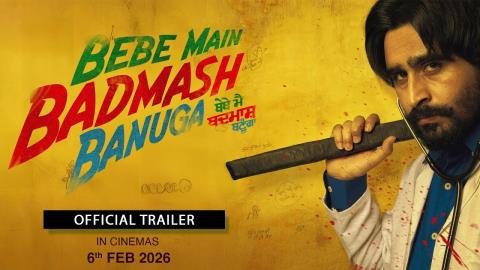
Let me tell you, the tagline of this film hit the hall before the opening scene even finished. “In growing age, there is a bug that troubles a lot. It is the bug of being a badmash.” The audience laughed. Then the film showed them that this bug is not funny at all. By the interval, the laughter had turned into something heavier and more honest.
Director Sukhminder Dhanjal delivers one of the more emotionally grounded Punjabi films of early 2026. Bebe Mein Badmash Banunga does not romanticise the gangster life. It traces exactly how a good boy becomes one, step by step, humiliation by humiliation, and it makes you feel every single step along the way.
Bebe Mein Badmash Banunga (2026) – Movie Overview
| Detail | Information |
|---|---|
| Movie Name | Bebe Mein Badmash Banunga |
| Release Date | February 6, 2026 |
| Language | Punjabi |
| Genre | Coming-of-Age Drama, Action, Social Crime Drama |
| Director | Sukhminder Dhanjal |
| Writer | Sukhminder Dhanjal |
| Producers | R Rupaali Gupta, Jagjeet Sandhu |
| Production House | Friday Rush Motion Pictures, Jagjeet Sandhu Films |
| Lead Actor (Himmat) | Jagjeet Sandhu |
| Lead Actress | Aveera Singh Masson |
| Mother (Bebe) | Satwant Kaur |
| Supporting Cast | Raghavv Bbhanot, Ashish Duggal, Sanju Solanki, Paramveer Singh, Rahul Jungral |
| Runtime | 129 minutes |
| Censor Certificate | PG – Violence |
| IMDB Rating | 9.9 / 10 (Early Audience Votes) |
| Opening | Decent opening in Punjab driven by Jagjeet Sandhu fanbase |
| OTT Release | Not announced yet |
Brief Overview – What Is Bebe Mein Badmash Banunga About?
Himmat is a kind-hearted nursing student who is mocked relentlessly for his softness. He is not weak. He is simply decent in a world that mistakes decency for weakness. Tired of being laughed at, he makes a decision to reinvent himself as a badmash by learning the ways of the streets from a feared local gangster.
Also Read




What begins as a playful, almost comic experiment quickly spirals into something real and dangerous. Love, conflict, ambition, and the thin line between seeking respect and losing your soul all collide as Himmat transforms from a simple nursing student into someone his Bebe can barely recognise. The film’s emotional centre is not the action. It is a mother waiting at the door for a son who is slowly becoming a stranger.
Section 1: The Story – A Bug That Grows Into a Beast
Sukhminder Dhanjal writes a screenplay that understands something most Punjabi action dramas miss. No good boy becomes a badmash overnight. It happens in small, quiet moments of humiliation that accumulate until something breaks. Dhanjal shows us every single one of those moments with Himmat and by the time the character makes his choice, you understand it completely even if you cannot endorse it.
The first half is the stronger half by a significant margin. Himmat’s transformation is handled with patience and real psychological insight. The comedy of watching a gentle nursing student try to learn aggression from a gangster is genuinely funny without ever making the situation feel frivolous.
The second half is where the screenplay dips. The romantic track involving Aveera Singh Masson feels like a detour rather than an integrated part of the story. Some action sequences lean too heavily on conventions already seen in recent Punjabi gangster films. The emotional momentum built in the first half slows down just when it should be accelerating toward the climax.
Section 2: Performances – Sandhu Carries Every Frame
Jagjeet Sandhu as Himmat
Jagjeet Sandhu is the reason this film works as well as it does. He plays the duality of Himmat with complete conviction. His body language as the shy, stumbling nursing student in the first half is completely different from his physicality as the street-hardened badmash in the second. This is not a costume change. It is a full character transformation executed through performance.
His scenes with Satwant Kaur as his mother are the film’s most emotionally honest moments. He listens in those scenes, really listens, and you can see the guilt of a son who knows exactly what he is putting his Bebe through. That guilt is what keeps Himmat from becoming a simple gangster trope. He remains human even when his choices are not.
Satwant Kaur as Bebe
Satwant Kaur is the emotional anchor of the entire film. Her Bebe is not a weeping prop. She is a woman of fierce dignity who raised her son with everything she had and now watches helplessly as the world undoes her work. Her silences carry more weight than most characters’ speeches. She deserves every award Punjabi cinema can offer for this role.
Aveera Singh Masson
Aveera Singh Masson brings a refreshing presence to the romantic track and shares natural chemistry with Jagjeet Sandhu. The limitation is not her performance. The limitation is the script which uses her primarily to support Himmat’s arc rather than giving her a story of her own. She makes the most of every scene she gets.
Raghavv Bbhanot and Ashish Duggal
Raghavv Bbhanot continues his run of playing effective antagonists in Punjabi cinema with authority. Ashish Duggal brings the necessary menace and conflict to Himmat’s journey through the criminal world. Both actors add the credibility the film needs from its darker supporting characters.
Section 3: Technical Craft – Punjab in Two Lights
The cinematography makes one of the film’s most intelligent technical decisions. Rural Punjab and urban Punjab are lit and shot differently, separating Himmat’s two lives visually without ever having to spell it out in dialogue. The warmth of his home and Bebe’s world is contrasted against the harsher, cooler light of the streets where the badmash version of Himmat operates. It is subtle work that rewards attention.
The soundtrack is energetic and largely fits the film’s tashan. There is a strong mix of soulful tracks for the emotional scenes and upbeat numbers for the action sequences. No single song breaks through as a major standalone chartbuster but the music serves the film consistently without ever becoming a distraction.
| Aspect | Rating | Comment |
|---|---|---|
| Lead Performance (Jagjeet Sandhu) | 4.5 / 5 | Career-defining dual transformation. Completely believable in both halves. |
| Satwant Kaur as Bebe | 5 / 5 | The emotional spine of the film. Every scene she is in belongs to her. |
| Supporting Performances | 3.5 / 5 | Solid across the board. Bbhanot and Duggal deliver. |
| First Half Screenplay | 4 / 5 | Patient, psychologically sharp, genuinely funny in places. |
| Second Half Screenplay | 2.5 / 5 | Loses momentum. Romantic track feels separate from the main story. |
| Cinematography | 4 / 5 | Smart visual contrast between Himmat’s two worlds. |
| Music | 3 / 5 | Consistent and fitting. No standalone chartbuster. |
| Direction | 3.5 / 5 | Confident handling of the premise. Better in the first half. |
Section 4: Moments That Stay With You
- The First Humiliation: The opening scenes of Himmat being mocked by local toughs outside his nursing college. Jagjeet Sandhu plays the quiet devastation of these moments without ever making the character pathetic. You root for him immediately and completely.
- The Decision Scene: Himmat watches the feared local gangster command instant respect simply by walking into a room. The way Sandhu’s eyes change in that moment is the film in miniature. You see the bug bite him in real time.
- First Training Sequence: Himmat attempting to learn aggression from his mentor is the film’s funniest stretch. The comedy comes from the total sincerity of a gentle man trying to be something he fundamentally is not. Yet.
- Bebe’s Kitchen Scene: A quiet domestic moment between Himmat and his mother mid-film. She has not yet understood what is changing in her son. He has not yet admitted it to himself. Satwant Kaur and Jagjeet Sandhu make this the most devastating scene in the film without raising their voices once.
- The Final Confrontation: When Himmat faces the men who first humiliated him. The scene should feel triumphant. Dhanjal makes sure it does not feel entirely triumphant. That ambivalence is the most honest thing the film does.
Section 5: Theatre vs OTT – Does It Earn the Big Screen?
Bebe Mein Badmash Banunga is not a spectacle film. Its power comes from performance, emotional truth, and the specific textures of its two Punjabs. These elements travel well to any screen size. A home OTT experience with good audio will serve this film just as well as a multiplex.
That said, watching Jagjeet Sandhu’s physical transformation on a large screen in the second half has an impact that a smaller screen dilutes. If it is showing near you, the theatre experience is the better first watch. If you missed it, do not wait too long for OTT. This is the kind of film that deserves to be seen with your full attention.
| Format | Verdict |
|---|---|
| Theatre with Jagjeet Sandhu Fans | Excellent choice. His performance hits harder on a big screen with a reactive crowd. |
| Theatre with Family | Good option. The mother-son dynamic resonates powerfully in a shared viewing experience. |
| OTT with Family | Recommended. This film is perfectly suited for attentive home viewing with adult family members. |
| OTT Solo Watch | Very good. Give it your full attention and the emotional beats will land exactly as intended. |
Section 6: Who Will Love Bebe Mein Badmash Banunga?
Mass Appeal: Fans of Jagjeet Sandhu who have followed his work across Punjabi and Hindi cinema and know his range. Viewers who enjoy coming-of-age dramas that take their subject seriously. Families who want a film that has action and comedy but also says something real about what shapes a young man’s choices.
Class Appeal: Cinephiles will appreciate the screenplay’s psychological precision in the first half, the dual visual language of the cinematography, and Satwant Kaur’s extraordinary understated performance as a mother who says more with her back turned than most characters say in an entire scene.
Think: The emotional depth of Jatt and Juliet 3 meets the raw social commentary of Sufna, filtered through a coming-of-age framework that refuses to make its protagonist either a hero or a villain.
Final Verdict – Is Bebe Mein Badmash Banunga Worth Watching?
Yes. With genuine enthusiasm and one honest caveat about the second half. Bebe Mein Badmash Banunga is not a perfect film but it is an important one. It asks a question that Punjabi cinema should be asking more often: what does a society owe the young men it mocks into becoming the monsters it then fears?
Jagjeet Sandhu gives the performance of his career. Satwant Kaur gives one of the finest supporting performances in recent Punjabi cinema history. Sukhminder Dhanjal directs the first half with real confidence and emotional intelligence. The second half stumbles but never falls.
Watch it for the performances. Stay for what it says about the boys who become badmash not because they want to, but because no one ever showed them another way to be respected.
Frequently Asked Questions
1. Is Bebe Mein Badmash Banunga suitable for family viewing?
The film carries a PG with Violence certificate and is appropriate for teenagers and adults. The violence is not graphic but the themes of street crime, social humiliation, and moral compromise are mature. Young children may not connect with the story but older teenagers and adult family members will find it a rewarding and emotionally honest watch together.
2. Is this film similar to other Punjabi gangster films like Dakuaan Da Munda?
Not quite. Bebe Mein Badmash Banunga is less interested in glorifying the gangster lifestyle and more interested in understanding how ordinary boys enter it. It has action and attitude but its primary concern is emotional and social rather than spectacular. Viewers expecting wall-to-wall action in the Dakuaan Da Munda style will find this film quieter and more reflective in its approach.
3. When will Bebe Mein Badmash Banunga release on OTT?
No official OTT release date has been announced as of February 2026. The film released in theatres on February 6, 2026 and a digital streaming announcement is expected within 4 to 6 weeks of the theatrical release. Always watch through a licensed OTT platform and avoid piracy websites.

Priyanka Das is an SEO expert and digital researcher based in Didwana-Kuchaman, Rajasthan, India. He is the founder and sole creator of Filmyzilla99.in, where he researches and publishes informational content on Movies Review using trusted sources. While not a movie professional, his work focuses on accurate research, clear explanations, and responsible content practices to help readers better understand Movies Review topics.