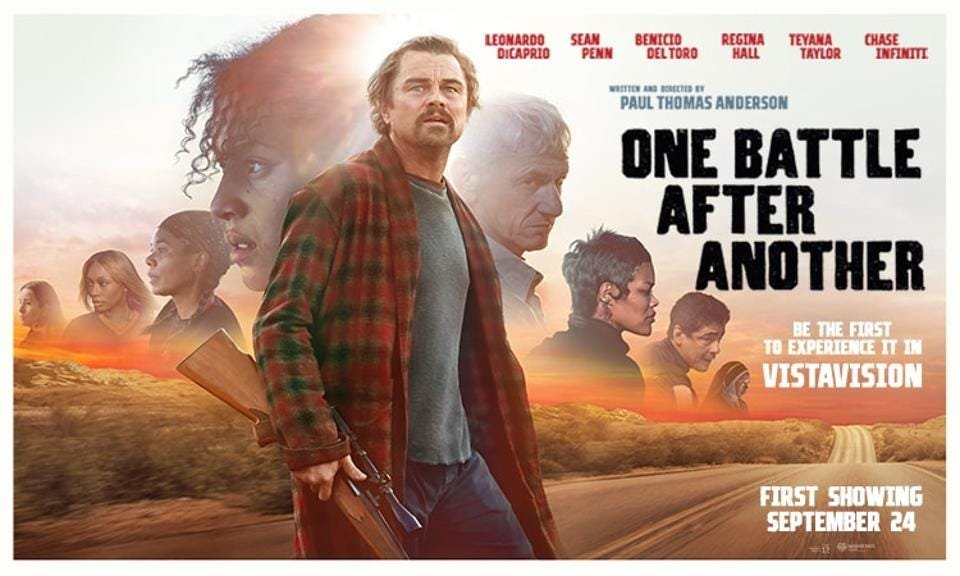
Paul Thomas Anderson has spent 30 years making films that feel like they were made for a very specific kind of audience. One Battle After Another is the first time he has made something that feels like it was made for everyone, and it is also, somehow, his most personal film yet.
A nearly three-hour black comedy action thriller about a washed-up revolutionary trying to protect his daughter in an authoritarian America. It sounds exhausting on paper. It is pure adrenaline on screen.
Released theatrically on September 26, 2025, the film opened to a 94 percent Rotten Tomatoes score from 434 critics. It swept the 2026 BAFTA Awards with six wins including Best Film and Best Director.
It arrives on JioHotstar in India on February 26, 2026, giving Indian audiences their first streaming access to the most decorated film of the 2025-26 awards season.
Also Read




One Battle After Another (2025) – Film Overview
| Detail | Information |
|---|---|
| Film Name | One Battle After Another |
| India OTT Platform | JioHotstar (February 26, 2026) |
| US Streaming | HBO Max (December 19, 2025) |
| Theatrical Release | September 26, 2025 (Worldwide) |
| Distributor | Warner Bros. Pictures |
| Language | English |
| Genre | Black Comedy, Action Thriller, Political Drama |
| Director and Writer | Paul Thomas Anderson |
| Producers | Joanne Sellar, Paul Thomas Anderson, Adam Somner (dedicated to), Will Weiske, Sara Murphy |
| Cinematographer | Paul Thomas Anderson (VistaVision format) |
| Music | Jonny Greenwood (London Contemporary Orchestra) plus two songs by Jon Brion |
| Bob Ferguson | Leonardo DiCaprio |
| Colonel Steven Lockjaw | Sean Penn |
| Benicio Del Toro | Key Supporting Role |
| Perfidia Beverly Hills | Teyana Taylor |
| Willa Ferguson (Bob’s Daughter) | Chase Infiniti (Film Debut) |
| Regina Hall | Key Supporting Role |
| Based On | Vineland (1990 novel by Thomas Pynchon), with original material by Anderson |
| Runtime | 2 hours 41 minutes |
| Content Rating | R (Mature themes, action violence) |
| Budget | Approximately USD 175 million |
| Worldwide Box Office | USD 208.7 million (box office disappointment vs break-even of USD 300 million) |
| Rotten Tomatoes | 94% (434 critics) |
| IMDB | 7.7 / 10 |
| BAFTA Wins | 6 wins including Best Film, Best Director, Best Supporting Actor (Sean Penn) |
| Golden Globe Wins | Best Motion Picture Musical or Comedy, Best Director, Best Screenplay |
| Critics Choice Award | Best Picture |
| Sight and Sound Poll | Best Film of 2025 |
| Academy Award Nominations | 13 nominations |
| Filming Format | VistaVision (one of the first films to use format since the 1960s) |
Brief Overview – What Is One Battle After Another About?
Bob Ferguson is a paranoid, shambolic, off-grid ex-revolutionary who has spent 16 years trying to pretend his past does not exist. His peaceful if chaotic life with his daughter Willa is destroyed when Colonel Lockjaw, the fascist military officer who has been hunting Bob for years, resurfaces with a clear intent to finish what he started.
Bob is forced off the couch and back into the fight. His old comrades, including the incendiary Perfidia Beverly Hills, are drawn back in with him.
The film builds from domestic comedy into something larger, darker, and more politically charged as Bob and the people around him discover that the authoritarian forces they thought they had left behind have not left them at all.
Section 1: The Story – A Three-Hour Panic Attack With an Optimistic Heart
Anderson has wanted to adapt Thomas Pynchon’s Vineland since the early 2000s. The two decades of waiting are visible in how deeply the material has merged with his own concerns.
This is not a faithful adaptation. It is Anderson absorbing a novel and producing something entirely his own. Letterboxd reviewers described it as a dystopian drama where the ruined world is not one of fiction but the one we already live in.
The political resonance was baked into the original novel. It arrived in the real world’s face when the January 2026 Minneapolis ICE shootings made the film’s themes of militarised authority and neighbourhood destabilisation devastatingly contemporary.
Producer Sara Murphy described the timing as something the team could not have anticipated. The film does not need that context to work. But it explains why audiences who watched it in late 2025 and early 2026 reported feeling physically shaken by what they saw.
The first act sets up a great deal and some viewers report getting momentarily lost. Stick with it. The film rewards patience with a second act that is among the most sustained passages of brilliant filmmaking PTA has produced in his career.
The comedy is consistent, the action is adrenaline-pure, and the emotional stakes build to a final hour that hits harder than the film has any right to given how funny it is.
Section 2: Performances – DiCaprio Finally Cuts Loose
Leonardo DiCaprio as Bob Ferguson
Critics have described this as DiCaprio being unlocked by comedy in a way the actor’s filmography had never quite allowed before. Bob Ferguson is not a smooth operator or a commanding presence. He is a paranoid, fumbling, genuinely hapless man whose revolutionary instincts have been buried under 16 years of self-medication and avoidance.
DiCaprio plays the vulnerability with complete commitment and the result is his most relatable, most human, and arguably most impressive screen performance. Collider’s review described it as DiCaprio and Anderson’s film, their summit meeting, and the summit delivered.
Sean Penn as Colonel Lockjaw
Penn plays a white supremacist fascist military officer and does it without a single moment of cartoonishness. His Colonel Lockjaw is methodical, ideologically confident, and genuinely terrifying precisely because Penn refuses to signal to the audience that the character knows he is wrong.
His BAFTA win for Best Supporting Actor was the most widely predicted individual award of the 2026 season. It was earned completely.
Teyana Taylor as Perfidia Beverly Hills
Taylor’s performance generated significant cultural debate. Critics described her work as eruptive and steaming with revolutionary zeal.
Taylor herself responded to criticism about the character’s sexualisation by stating directly that showing what Black women go through, including being fetishised and underprotected, is a hard reality that the film has a responsibility to portray. Her engagement with the material is total and the performance is one of the year’s finest.
Chase Infiniti as Willa Ferguson
This is Chase Infiniti’s film debut and it is one of the most impressive debut performances in recent Hollywood cinema. She earned a BAFTA Rising Star nomination and significant individual critical attention. Her Willa is the film’s emotional core and Infiniti carries that weight with a naturalness that should not be possible for a first feature film performance.
Section 3: Technical Craft – VistaVision, Jonny Greenwood, and the Return of Jon Brion
Anderson shot the film himself in VistaVision, a widescreen format that had not been used seriously since the 1960s. The visual grandeur this produces is the film’s most immediately arresting technical quality. Every frame has a width and depth that makes the California locations feel mythic rather than merely scenic.
It was the first Anderson film released in IMAX and critics specifically singled out the IMAX 70mm presentations as among the finest theatrical experiences the format has offered.
Jonny Greenwood’s sixth Anderson collaboration produces what multiple critics called the score of 2025. The London Contemporary Orchestra recording gives the film a propulsive, atmospheric musical identity that is simultaneously rooted in the period Pynchon was writing about and utterly contemporary.
Two songs by Jon Brion, marking his first Anderson collaboration since Punch-Drunk Love in 2002, add a specifically warm and slightly melancholic texture to the film’s emotional passages.
| Aspect | Rating | Comment |
|---|---|---|
| Leonardo DiCaprio as Bob | 5 / 5 | Career-best. Comedy unlocks something the dramatic roles never could. |
| Sean Penn as Lockjaw | 5 / 5 | BAFTA-winning. Cold, methodical, and genuinely terrifying. |
| Teyana Taylor as Perfidia | 4.5 / 5 | Eruptive and fully committed. One of 2025’s finest supporting performances. |
| Chase Infiniti as Willa | 5 / 5 | Debut performance that announces a major new screen presence. |
| Direction (Paul Thomas Anderson) | 5 / 5 | His most entertaining film without sacrificing any of his thematic depth. |
| Cinematography (VistaVision) | 5 / 5 | Visually unlike anything else made this decade. IMAX viewing is transformative. |
| Jonny Greenwood Score | 5 / 5 | The best film score of 2025. An Oscar win would be long overdue. |
| First Act Pacing | 3.5 / 5 | Sets up a great deal. Some viewers get temporarily lost before it clicks. |
Section 4: Moments That Define the Film
- Bob’s Introduction: The opening sequence establishes Bob Ferguson’s current state with such specific comic detail that you understand the entire 16-year gap instantly. DiCaprio’s physical comedy here is the first signal that something completely different is happening in this film.
- Lockjaw’s First Appearance: Sean Penn arriving on screen and the specific stillness with which he surveys every room he enters. The threat is established without a single act of violence in the first scene. That restraint is what makes everything that follows land harder.
- Perfidia’s Arrival: Teyana Taylor’s entrance is staged as a full rupture of the film’s preceding rhythm. The energy she introduces does not leave for the rest of the film.
- The Central Action Sequence: The film’s largest set piece in the second act. Anderson shooting action in VistaVision produces images that critics described as genuinely awe-inspiring. It is the kind of sequence that makes you understand why people went to see it twice.
- Bob and Willa’s Final Scene: The film ends on a note of earned, unforced hope. After nearly three hours of escalating chaos, Anderson delivers a closing image that Letterboxd reviewers described as the film’s silver lining, hereditary, passed from generation to generation alongside the baggage they saddle us with, but strong enough to beat back everything else.
Final Verdict
One Battle After Another is the best film of 2025 and one of the finest American films of the decade. It is Paul Thomas Anderson at his most accessible and his most ambitious simultaneously, which should be impossible and is not. DiCaprio gives the performance of his career.
Penn gives the performance of his recent career. Chase Infiniti arrives fully formed. Jonny Greenwood’s score is transcendent. The VistaVision cinematography is unlike anything the film industry has produced since the format was abandoned sixty years ago.
It lost money in theatres. It won six BAFTAs, three Golden Globes, the Critics Choice Best Picture, and the Sight and Sound annual critic poll. History will be very clear about what that ratio means. Watch it on JioHotstar from February 26. Watch it on the largest screen you have available. Then watch it again.
Frequently Asked Questions
1. Where can Indian viewers watch One Battle After Another?
The film streams exclusively on JioHotstar in India from February 26, 2026. It is available to JioHotstar subscribers across all tiers. There is no confirmation of availability on Netflix or Amazon Prime Video India.
In the US it has been streaming on HBO Max since December 19, 2025, and is also available for digital rental and purchase on Prime Video, Apple TV, and Fandango at Home.
2. Is One Battle After Another based on a true story?
No. The film is inspired by Thomas Pynchon’s 1990 novel Vineland and incorporates original material written by Anderson. It is entirely fictional.
However, the film’s depiction of militarised authority, political suppression, and community destabilisation has been widely described as devastatingly timely given real events in early 2026 America. The themes are drawn from historical and contemporary political reality but the characters and story are invented.
3. How many Oscars did One Battle After Another win?
The film received 13 Academy Award nominations for the 2026 Oscars ceremony. The full list of wins will be confirmed at the Oscar ceremony in March 2026.
Heading into the ceremony it is one of the lead contenders with six BAFTA wins, three Golden Globe wins, and the Critics Choice Best Picture award already secured. Jonny Greenwood’s score and Paul Thomas Anderson’s direction are considered among the strongest contenders for wins on Oscar night.

Priyanka Das is an SEO expert and digital researcher based in Didwana-Kuchaman, Rajasthan, India. He is the founder and sole creator of Filmyzilla99.in, where he researches and publishes informational content on Movies Review using trusted sources. While not a movie professional, his work focuses on accurate research, clear explanations, and responsible content practices to help readers better understand Movies Review topics.