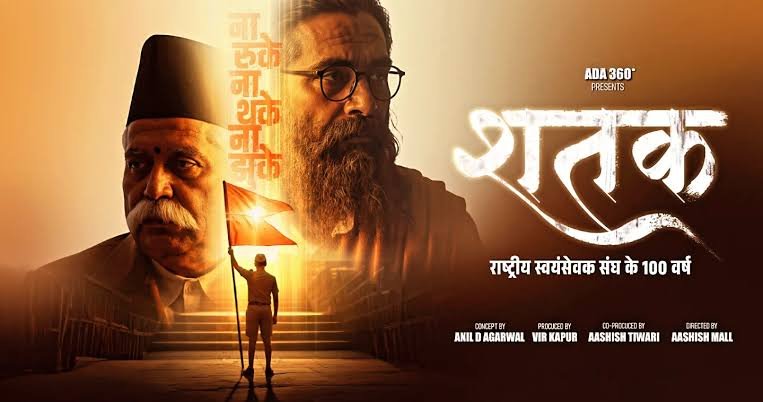
Let me tell you, when Ajay Devgn’s voice opens this film and says “A century is not merely a milestone in time, it represents generations of commitment, sacrifice, and contribution towards nation-building,” the weight of that statement lands immediately.
Shatak is not a neutral film. It is an authorised tribute. Knowing that going in is the only honest way to watch it.
Directed by Aashish Mall and released nationwide on February 20, 2026, Shatak: Sangh Ke 100 Varsh chronicles the 100-year journey of the Rashtriya Swayamsevak Sangh from its founding in 1925 to the present day.
Also Read




It is a cinematic tribute presented by ADA 360 Degrees LLP and produced by Vir Kapur, with Panorama Studios as distribution partner.
Shatak: Sangh Ke 100 Varsh (2026) – Film Overview
| Detail | Information |
|---|---|
| Film Name | Shatak: Sangh Ke 100 Varsh |
| Release Date | February 20, 2026 (Nationwide Theatrical) |
| Language | Hindi |
| Genre | Documentary Feature Film, Historical, Patriotic |
| Director | Aashish Mall |
| Concept | Anil Dhanpat Agarwal |
| Producer | Vir Kapur (ADA 360 Degree LLP) |
| Co-Producer | Aashish Tiwari |
| Associate Producer | Pavan Sindhi, Kabir Sadanand |
| Distribution | Panorama Studios |
| Narrator | Ajay Devgn |
| Songs | Sukhwinder Singh |
| Song Titles | Bharat Maa Ke Bacche, Bhagwa Hai Meri Identity |
| Subject | 100 Years of Rashtriya Swayamsevak Sangh (RSS), founded 1925 |
| Songs Released By | RSS Sarsanghchalak Dr. Mohan Bhagwat at Keshav Kunj, Jhandewalan |
| Motto Featured | Na Ruke, Na Thake, Na Jhuke |
| OTT Release | Not announced yet |
Brief Overview – What Is Shatak About?
Shatak traces the founding of the RSS by Dr. Keshav Baliram Hedgewar in Nagpur in 1925 through a century of ideological evolution, social work, political controversy, and mass volunteer movement building.
The film covers lesser-known chapters including the RSS’s role during the Independence movement, the Emergency period, disaster relief work, and its continuing grassroots presence across India.
The film positions itself as a researched historical narrative aimed at placing the RSS’s story in documented context. It is presented as a tribute to the millions of swayamsevaks whose service, in the makers’ words, has formed the backbone of the organisation’s hundred-year journey.
Section 1: The Film – An Authorised Portrait, Honestly Presented
Shatak does not pretend to be a neutral examination of the RSS. It is a centenary tribute made with the organisation’s co-operation and released with the RSS Sarsanghchalak’s official participation at its song launch.
Viewers who understand this going in will engage with it on its own terms. Viewers expecting a balanced critical documentary will be disappointed.
Within those terms, the film does its job well. It covers a hundred years of organisational history with reasonable narrative clarity, moves through key periods without losing the audience, and uses archival material, oral testimony, and visual storytelling to build a picture of the RSS from the inside.
Director Aashish Mall keeps the pace tight enough that the film does not feel like a hagiographic slideshow even when the framing is entirely sympathetic.
The film’s stated goal is to document lesser-known chapters and inspire younger generations through the principle of Nation First. As a piece of historical communication aimed at that specific audience, it succeeds. As an independent work of documentary cinema, it is less ambitious than it could be.
Section 2: Narration and Music
Ajay Devgn as Narrator
Devgn’s voice is the film’s single greatest asset. His deep, measured delivery gives the historical material weight and dignity without turning into propaganda theatre.
He said publicly that narrating this story was truly an honour for him. That sincerity is audible in every line. He never oversells the emotion and the restraint serves the film well across its runtime.
Sukhwinder Singh – Songs
Sukhwinder Singh performs both original songs, Bharat Maa Ke Bacche and Bhagwa Hai Meri Identity, with the full-throated patriotic energy that has defined his career. The songs function as anthems rather than conventional film songs.
They are rousing, unambiguous, and designed to be remembered after the credits roll. Whether that style connects with a viewer depends entirely on their relationship with the ideology at the film’s centre.
Section 3: Technical Craft
The cinematography handles archival integration and original footage with reasonable technical competence. The visual language is clean and respectful rather than cinematic in any ambitious sense.
The film is not trying to be Shoah or Senna. It is trying to be a dignified institutional portrait and it achieves exactly that.
The sound design gives Devgn’s narration the space it needs. The background score supports the film’s patriotic register without becoming overbearing. The overall production value is appropriate for a film of this type and budget.
| Aspect | Rating | Comment |
|---|---|---|
| Ajay Devgn Narration | 4.5 / 5 | Measured, dignified, the film’s strongest element. |
| Historical Coverage | 3.5 / 5 | Covers a century with reasonable clarity. Sympathetic framing throughout. |
| Music (Sukhwinder Singh) | 3.5 / 5 | Rousing patriotic anthems. Effective within the film’s intent. |
| Direction (Aashish Mall) | 3 / 5 | Competent. Keeps pace without over-dramatising. |
| Cinematography | 3 / 5 | Clean archival integration. Not cinematically ambitious. |
| Objectivity | 1.5 / 5 | This is an authorised tribute, not a neutral documentary. |
Section 4: Moments Worth Noting
- The 1925 Founding Sequence: The film opens with the Nagpur founding of the RSS under Dr. Hedgewar. The visual recreation of this moment sets the tone for everything that follows and gives the film its historical anchor.
- The Emergency Period Chapter: The section covering the RSS during the 1975-77 Emergency is the film’s most historically consequential stretch. The material here is genuinely significant regardless of ideological perspective.
- Disaster Relief Documentation: Archival and documentary footage of RSS volunteers during natural disasters is the film’s most broadly appealing section. Swayamsevak ground-level work in floods and earthquakes is shown without political framing and lands as straightforward human documentation.
- Devgn’s Closing Narration: The final section where Devgn ties together the century with a reflection on what a hundred years of a movement means for a nation. His voice at its most restrained here. The most cinematic moment the film produces.
- Bhagwa Hai Meri Identity Performance Sequence: Sukhwinder Singh’s second anthem presented with visual montage of swayamsevaks across generations. The film’s most emotionally direct moment for its intended audience.
Section 5: Theatre vs OTT
Shatak is a theatrical experience primarily for its intended audience. The communal viewing experience of a patriotic documentary with an auditorium of like-minded viewers is part of how this type of film functions. Organisational screenings and group viewings are already being organised across India.
For general audiences, OTT will serve this film adequately once the digital release is confirmed. The film does not require large-screen spectacle to deliver its content.
| Format | Verdict |
|---|---|
| Theatre – Organised Group Screening | Best experience for the intended audience. Communal viewing amplifies the film’s impact. |
| Theatre – General Audience | Worthwhile for viewers interested in RSS history regardless of ideological position. |
| OTT at Home | Adequate. The content travels well to any screen once the digital release arrives. |
Section 6: Who Should Watch Shatak?
Primary Audience: RSS members, swayamsevaks, and supporters who want to see the organisation’s hundred-year journey presented on the big screen. Families with a strong connection to the Sangh’s values and history. Anyone who participated in or was moved by the RSS centenary celebrations of 2025.
Broader Audience: Students of modern Indian political and social history who want one perspective on the RSS’s evolution. Viewers interested in how large voluntary organisations document and present their own histories. Ajay Devgn fans curious about his narration work.
Not For: Viewers seeking a critical or balanced examination of the RSS. Those who want the kind of documentary that challenges its subject rather than celebrates it.
Final Verdict
Shatak: Sangh Ke 100 Varsh is exactly what it presents itself to be. A centenary tribute to the RSS, made with the organisation’s participation, narrated by one of Bollywood’s most trusted voices, and released to coincide with a historic milestone.
It does not pretend to be something it is not and that honesty is the most useful thing a reviewer can reflect back to a potential audience.
For its intended audience it is essential viewing. For curious general viewers it is an informative if one-sided window into how one of India’s most significant organisations understands its own hundred-year story. Ajay Devgn’s narration alone makes it worth the ticket for anyone on the fence.
Frequently Asked Questions
1. Is Shatak a documentary or a feature film?
It is classified as a documentary feature film. It uses a combination of archival footage, historical recreation, oral documentation, and original cinematography to tell the RSS’s hundred-year story.
It does not have fictional characters or a dramatic narrative structure. It is best understood as a full-length documentary presented in theatrical format.
2. Why is Ajay Devgn the narrator of Shatak?
Devgn was chosen for his iconic voice and his standing as one of Bollywood’s most respected actors.
He has publicly expressed pride in being associated with the film, calling it an honour to narrate a story about a century of commitment and nation-building. His involvement has given the film its widest public visibility ahead of release.
3. Is Shatak suitable for all ages?
Yes. The film contains no adult content, violence, or objectionable material. It is a patriotic historical documentary suitable for all age groups.
The makers have specifically invited families to watch it together in theatres and have positioned it as an educational and inspirational experience for younger generations interested in India’s modern organisational and social history.

Priyanka Das is an SEO expert and digital researcher based in Didwana-Kuchaman, Rajasthan, India. He is the founder and sole creator of Filmyzilla99.in, where he researches and publishes informational content on Movies Review using trusted sources. While not a movie professional, his work focuses on accurate research, clear explanations, and responsible content practices to help readers better understand Movies Review topics.