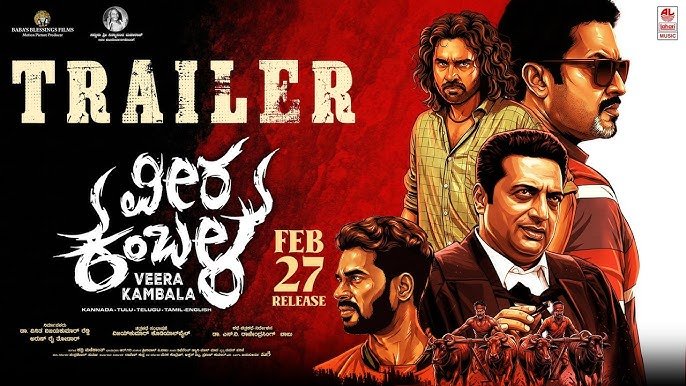
The man who gave Karnataka Raktha Kashmira after an 18-year wait is back in theatres on the very same day Raktha Kashmira hits OTT. S.V. Rajendra Singh Babu, the three-time National Award-winning director, is releasing Veera Kambala on February 27, 2026.
A Kannada-Tulu bilingual sports drama built around one of coastal Karnataka’s most iconic and endangered cultural traditions. The premise alone sets it apart from everything else releasing this week.
Made at a budget of Rs 14 crore and backed by AR Productions, Veera Kambala features Prakash Raj in the lead alongside Radhika Chethan, Naveen D Padil, Ravi Shankar, and Dushyanth Adithya.
The director has stated publicly that the film contains visuals and a story that will be discussed across the country and if the Kannada-Tulu response is strong, it will be dubbed into Hindi, Tamil, Telugu, and eventually English to take Kambala’s story to the world.
Also Read


Veera Kambala (2026) – Film Overview
| Detail | Information |
|---|---|
| Film Name | Veera Kambala (Birdd Kambala in Tulu) |
| Release Date | February 27, 2026 |
| Language | Kannada and Tulu (Bilingual) |
| Genre | Sports Drama, Action, Cultural Drama |
| Director | S.V. Rajendra Singh Babu |
| Production | AR Productions |
| Budget | Rs 14 Crore |
| Cinematographer | R. Giri |
| Editor | Srinivas P. Babu |
| Music | Manikanth Kadri |
| Lead Actor (Ramanna) | Prakash Raj |
| Lead Actress | Radhika Chethan |
| Supporting Cast | Naveen D Padil, Ravi Shankar, Dushyanth Adithya, Gopinath Bhat, Bhojaraj Vamanjoor, Usha Bhandary, Veena Ponnappa, Geetha Surathkal, Swaraj Shetty, Divya Vismitha, Srinivas Gowda |
| Special Appearance | Srinivasa Gowda (Real-Life Kambala Champion) |
| Release Region | Karnataka (Kannada), Tulunadu, Bengaluru, Mumbai, Dubai (Tulu) |
| Dubbed Plans | Hindi, Tamil, Telugu, English (if Kannada-Tulu run is successful) |
| OTT Release | Not announced yet |
Brief Overview – What Is Veera Kambala About?
Sixty-year-old Ramanna has one unfinished mission. His mother’s dying wish was to see Kambala, the traditional coastal Karnataka buffalo racing sport, revived on their village grounds after years of abandonment.
The event has not been held in decades due to a bitter, unresolved feud between the powerful Manjottiguttu and Mahabala families that tore the community apart.
Ramanna sets out to revive the Kambala and in doing so, to end the feud that has kept his village divided for a generation. What he faces is not just two stubborn families but political conspiracies working against the event, legal battles mounted to prevent it, and violent rivalries that are determined to keep the past buried.
The film builds to a climax where the village must confront everything it has been avoiding, and in confronting it, reclaim both its sport and its pride.
Section 1: The Story – A Son’s Promise and a Village’s Reckoning
S.V. Rajendra Singh Babu’s screenplay uses the Kambala revival as the story’s surface engine while the deeper engine is a generational conflict that has calcified into ideology. The Manjottiguttu and Mahabala families are not simply stubborn.
They represent two versions of what the village believes itself to be, and Ramanna’s mission is not just to organise a buffalo race but to make both sides remember what they share before what they dispute consumes what remains.
The political conspiracy subplot adds a layer of contemporary relevance. Kambala has faced real-world legal challenges and cultural politics in Karnataka and the film is clearly drawing on that reality.
The director said the film will show what Kambala means to coastal Karnataka and what is at stake when traditions face external pressure. The personal and the political are woven together with the confidence of a filmmaker who has spent decades understanding both.
The inclusion of real-life Kambala champion Srinivasa Gowda in a special appearance is the film’s most culturally specific gesture. Gowda became a national sensation in 2020 when his Kambala race timings were compared to Usain Bolt’s world record.
His presence in the film connects the fictional revival to a real movement of pride and recognition that coastal Karnataka has been building.
Section 2: Performances
Prakash Raj as Ramanna
Prakash Raj playing a 60-year-old man driven by a mother’s wish and a community’s unresolved grief is casting that requires no justification.
He is one of Indian cinema’s finest character actors and his ability to play dignity under pressure, the specific weight of a man who carries a cause longer than his own comfort, is precisely what Ramanna needs.
His Tulu dialogue delivery, given the bilingual nature of the film, has been specifically highlighted in pre-release coverage as something the coastal Karnataka audience will respond to with deep recognition.
Radhika Chethan
Radhika Chethan brings warmth and ground-level conviction to her role. Her character exists within the film’s emotional architecture as the story’s connective tissue between the family feud and the personal stakes at the film’s centre.
Details of her specific role have been kept close by the production but her presence in the film’s promotional material suggests a character with genuine agency rather than a supporting function.
Naveen D Padil, Ravi Shankar and the Ensemble
Naveen D Padil and Ravi Shankar are both established names in Kannada cinema and Tulu theatre and their involvement gives the film authentic cultural roots.
Gopinath Bhat and Bhojaraj Vamanjoor add the specific coastal Karnataka identity that a film about Kambala needs from its supporting cast to feel genuinely rooted rather than produced from a distance.
Usha Bhandary, Veena Ponnappa, and Geetha Surathkal round out an ensemble that reads as a collective rather than a star vehicle.
Section 3: Kambala – The Sport the Film Is Defending
Kambala is a traditional buffalo race held in the coastal districts of Karnataka, particularly in the Dakshina Kannada and Udupi regions. It has been practiced for centuries as part of the agricultural and cultural life of the Tulu-speaking communities.
In a Kambala race, a pair of buffaloes runs through a paddy field track while the jockey stands on a plank attached to the animals. Speed, skill, and the bond between the handler and the animals are all part of the tradition.
The sport has faced significant legal and political controversy. Animal rights campaigns led to temporary bans that were eventually overturned following massive public protests in Karnataka.
Srinivasa Gowda’s 2020 viral moment, when his timings of 100 metres in 9.55 seconds were widely circulated, brought global attention to a sport that most people outside coastal Karnataka had never heard of. Making a film about Kambala at this cultural moment is a statement about whose traditions deserve to be seen and celebrated.
Section 4: Technical Craft
R. Giri, who shot Raktha Kashmira for the same director, returns as cinematographer. His understanding of coastal Karnataka’s landscape, light, and physical textures is the film’s single most important technical asset. Kambala is a sport that happens in water-flooded paddy fields under specific coastal conditions.
Capturing it with the visual authority it deserves requires someone who knows what that landscape looks like when it is alive and what it looks like when it has been abandoned. Giri knows both.
Manikanth Kadri’s score draws on Tulu folk music traditions that give the film its specific cultural sound. The background score for the Kambala sequences in particular has been described in pre-release coverage as building to a visceral, rhythmically driving climax that makes the race feel like the event the entire film has been building toward.
The editing by Srinivas P. Babu will determine whether the pacing across the film’s running time sustains the tension the premise generates.
| Aspect | Pre-Release Assessment | Based On |
|---|---|---|
| Prakash Raj as Ramanna | Authoritative and culturally specific casting | Actor’s range and Tulu dialogue work in promotions |
| R. Giri Cinematography | Proven coastal Karnataka visual language | Raktha Kashmira collaboration and location knowledge |
| Manikanth Kadri Score | Tulu folk roots, race sequence build | Pre-release audio and promotional material |
| Kambala Sequences | High expectation | Director’s stated ambition and real-location shooting |
| Cultural Authenticity | Strong ensemble of coastal Karnataka artists | Cast and director’s regional roots |
| Budget vs Ambition | Rs 14 crore for a culturally significant sports drama | Director’s confidence and pan-India dubbing plans |
Section 5: Why Veera Kambala Matters Beyond the Film
- A Sport That Fought for Survival: Kambala is not simply entertainment. It is a legal battle won, a cultural identity defended, and a community’s way of saying the traditions that define us are not available for extinction. A film that tells that story is not just a sports drama. It is a document.
- S.V. Rajendra Singh Babu’s Second Release in a Single Day: Having Raktha Kashmira hit OTT and Veera Kambala hit theatres on the same day is either a scheduling coincidence or a statement about a director’s commitment to ensuring his films reach their audiences. Either way, both films deserve to be seen.
- Srinivasa Gowda’s Cameo: When the man whose race timings went globally viral appears in a film about his sport, the bridge between documentary reality and dramatic fiction closes in a way that gives the film a specific weight no scripted scene could manufacture.
- Tulu Language Visibility: The bilingual Kannada-Tulu release with specific screenings in Tulunadu, Bengaluru, Mumbai, and Dubai is a meaningful act of cultural visibility for a language that rarely receives this level of theatrical attention.
- Pan-India Potential: The director’s stated plan to dub into Hindi, Tamil, Telugu, and English if the initial run succeeds positions Kambala as a story the director believes deserves the same national and international curiosity that Jallikattu and other regional sports traditions have generated.
Final Verdict
Veera Kambala arrives with the weight of a tradition behind it and the craft of a director who has spent decades making films rooted in Karnataka’s cultural identity. Prakash Raj carrying a 60-year-old man’s mission to revive a community’s pride.
R. Giri shooting coastal Karnataka’s paddy fields and water tracks. Manikanth Kadri building toward a Kambala climax with Tulu folk rhythms. S.V. Rajendra Singh Babu directing a story that connects a son’s promise to an entire community’s reckoning.
The film is releasing today across Karnataka and Tulunadu. If coastal Karnataka responds the way Raktha Kashmira’s Karnataka audience did, the pan-India dubbing plans will move quickly. Give it the big screen it was made for. Kambala deserves to be seen at full speed.
Frequently Asked Questions
1. What is Kambala and why does it matter to coastal Karnataka?
Kambala is a traditional buffalo racing sport practiced in the coastal districts of Karnataka, primarily in the Dakshina Kannada and Udupi regions. It is a centuries-old tradition rooted in the agricultural calendar of Tulu-speaking communities. The sport involves a pair of buffaloes racing through flooded paddy field tracks with a handler guiding them.
It faced significant legal challenges from animal rights groups and was temporarily banned before large-scale public protests in Karnataka led to legislative protection. The sport became a symbol of coastal cultural identity and the right of communities to preserve their traditions.
2. In which languages is Veera Kambala releasing?
Veera Kambala is a bilingual release in Kannada and Tulu. The Kannada version releases across Karnataka on February 27, 2026, while the Tulu version, titled Birdd Kambala, releases simultaneously across Tulunadu and in select screens in Bengaluru, Mumbai, and Dubai.
Director S.V. Rajendra Singh Babu has stated that if the Kannada-Tulu run is commercially successful, the film will be dubbed into Hindi, Tamil, Telugu, and eventually English to bring the story of Kambala to national and international audiences.
3. Who is Srinivasa Gowda and why does his appearance in the film matter?
Srinivasa Gowda is a real-life Kambala champion from Karnataka who became a national and international sensation in February 2020 when video footage of his race went viral online.
His timings of 100 metres in 9.55 seconds were widely compared to Usain Bolt’s world record and sparked a massive surge of public pride in and awareness of Kambala as a sport.
His special appearance in Veera Kambala connects the film’s fictional story of Kambala’s revival to the real-world movement of recognition and celebration that the sport has been building since his viral moment.

Priyanka Das is an SEO expert and digital researcher based in Didwana-Kuchaman, Rajasthan, India. He is the founder and sole creator of Filmyzilla99.in, where he researches and publishes informational content on Movies Review using trusted sources. While not a movie professional, his work focuses on accurate research, clear explanations, and responsible content practices to help readers better understand Movies Review topics.